Church Tech · Oct 08, 2026 · 8 min read
How to Accept Tithes and Offerings Online in Nigeria (Paystack vs Flutterwave)
More members now carry their phone into service than their wallet. If the only way to give is cash in a bag or a bank transfer someone has to screenshot, a church is quietly losing seed, tithes and pledges every week — not because people don't want to give, but because giving is awkward.
This guide explains, without jargon, how Nigerian churches can accept tithes and offerings online, what it really costs, and the mistakes we see most often when we build church giving systems.
The three ways churches take money online
Bank transfer to the church account. Free, but every gift has to be matched by hand, nothing is recorded against the giver, and recurring tithes are impossible to track.
A payment link (Paystack or Flutterwave page) shared on WhatsApp. Quick to start, but it lives outside your website, gives no giving history, and looks less trustworthy to first-time visitors.
Giving built into the church website. Members choose tithe, offering, seed, building fund or a project, pay by card, bank or transfer, and every gift is recorded automatically. This is what a church website with online giving should do.
What it costs: Paystack vs Flutterwave
Both are licensed, widely trusted Nigerian payment providers. At the time of writing (October 2026), their published rates for local payments are:
Paystack: 1.5% + ₦100 per local transaction, with the ₦100 waived on payments under ₦2,500, and fees capped at ₦2,000 per transaction. International cards cost more (around 3.9% + ₦100).
Flutterwave: 2% per local transaction (shown as 1.4% transaction fee + 0.6% platform fee), plus 7.5% VAT on fees. International payments are listed at 4.8%.
Here's what that means for typical gifts, before VAT:
A ₦1,000 offering: Paystack about ₦15, Flutterwave about ₦20.
A ₦10,000 tithe: Paystack about ₦250, Flutterwave about ₦200.
A ₦200,000 building-fund pledge: Paystack hits its ₦2,000 cap; Flutterwave about ₦4,000.
In short: Paystack tends to be cheaper for very small and very large gifts thanks to its waiver and cap; Flutterwave can be slightly cheaper for mid-sized gifts. For most congregations the difference is small — reliability, payout speed and how well it fits your website matter more. Always confirm current rates on each provider's official pricing page before you decide.
Should the church pass the fee on to the giver?
Many churches add an optional "cover the processing fee" checkbox. Most members tick it, and the church receives the full amount. It's a better experience than silently adding a charge.
What you need to set it up
The church's CAC registration documents (incorporated trustees certificate) and a corporate bank account in the church's name — payment providers require these to activate live payments.
A clear list of giving categories: tithe, offering, seed, first fruit, building fund, missions, specific projects.
A decision on recurring giving: monthly tithes set up once are the single biggest improvement to predictable church income.
Someone in the finance team with a dashboard login to see and export giving records.
Five mistakes to avoid
Sending members to a payment page that doesn't carry the church's name and logo. People hesitate when the page looks unfamiliar.
No receipts. Every giver should receive an automatic thank-you and receipt by email.
No categories. If everything lands as "payment", your finance team ends up reconciling by hand anyway.
Forgetting the diaspora. Members abroad want to give in pounds or dollars — make sure international cards work, or add Stripe for UK and US givers.
Giving hidden three clicks deep. Put a Give button in the menu, on the homepage and inside your livestream page, where members actually are during service.
The better way: giving that's part of the whole church system
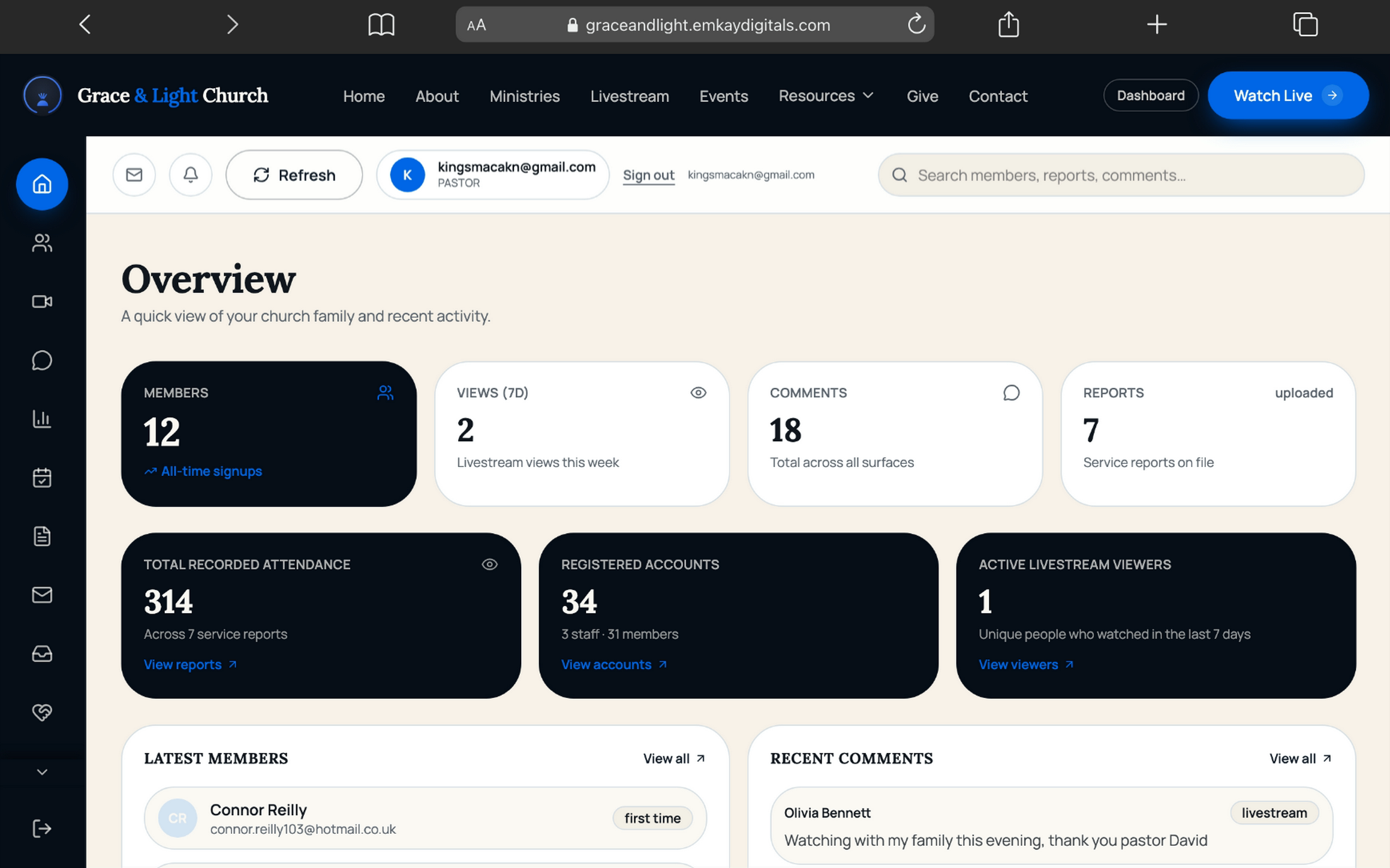
On the Emkay Church Platform, giving sits alongside livestream, membership, GPS check-in and messaging. A member can give during the livestream without leaving the page, recurring tithes run themselves, and the pastor sees giving records in a dashboard restricted to the pastor's access level. If you'd like to see it working with real data, book a walkthrough from the Church Platform page.